

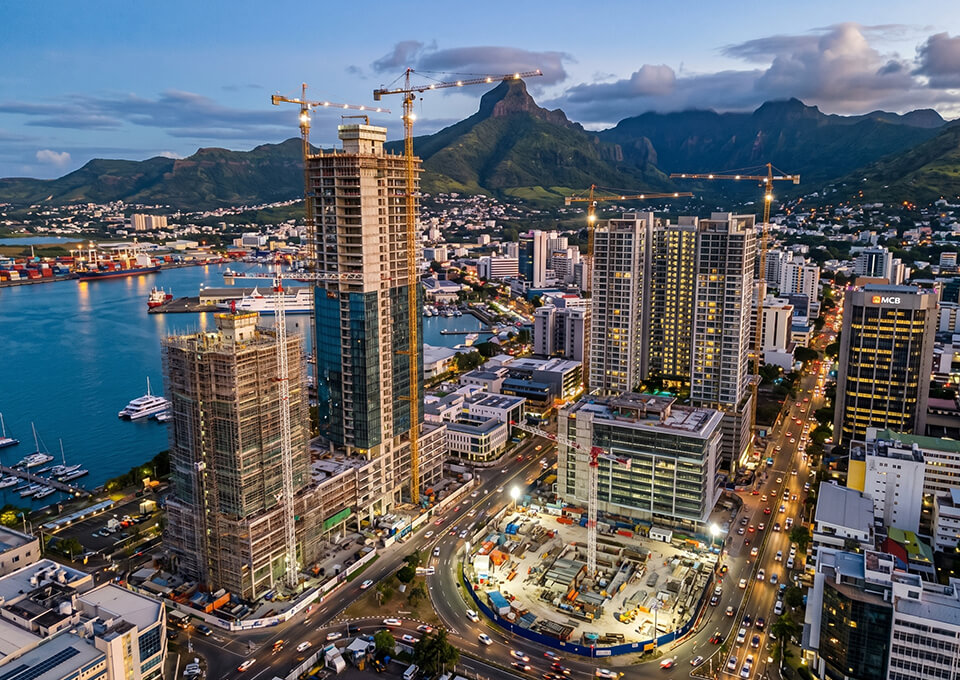
The Mauritius built environment is in a period of meaningful transformation in 2026, with a number of significant construction projects, spanning residential, commercial, hospitality, and infrastructure categories, currently under active construction or having recently been completed across the island. These projects are not only reshaping the physical landscape of specific areas of Mauritius but are also creating important supply-side dynamics in the real estate market that both local and international investors and buyers need to understand when making property decisions in the current environment.
The Apavou Group, founded by Armand Apavou and one of the most active and long-standing development groups in the Mauritius real estate market, continues to be an important contributor to this construction activity, building on the group’s track record of delivering quality developments including Plaisance Mall, Terre d’Été, and The Cube across more than four decades of continuous island development activity. Understanding the current construction landscape in Mauritius, both the projects being delivered by established groups like Apavou and the broader market context in which they are being delivered, is important context for anyone engaged with the Mauritius real estate market in 2026.
The smart city developments, reshaping urban patterns
The most transformative category of current construction activity in Mauritius in terms of its long-term urban impact is the Smart City programme, the government-endorsed framework for large-scale integrated urban developments that combine residential, commercial, educational, healthcare, and leisure components in comprehensively planned environments. Multiple Smart City developments are at various stages of construction and delivery across the island in 2026, collectively representing a significant volume of new mixed-use supply that will reshape the Mauritius urban landscape over the coming decade.
These Smart City developments range in scale from relatively focused mixed-use communities to large-scale urban environments that will eventually house thousands of residents and accommodate significant business activity. Their construction activity is visible across multiple parts of the island, from the northern regions to the central plateau and the southern and western development corridors. The quality and pace of delivery varies between different Smart City developments and developers, reflecting the different financial capacities, management capabilities, and market conditions affecting each project. For real estate buyers and investors considering property within Smart City developments, careful assessment of the specific developer’s financial strength, track record, and current project status is essential due diligence rather than an optional enhancement.
Premium residential supply, irs and pds pipeline
The pipeline of premium IRS and PDS scheme residential development, the categories of approved foreign-accessible property development that have been the primary vehicle for international buyer participation in the Mauritius residential market, continues to show meaningful activity in 2026, with several significant new developments either recently launched, currently under construction, or in advanced planning stages. This pipeline of new premium residential supply has important implications for the balance between supply and demand in the premium segment of the Mauritius residential market, and for the pricing dynamics that different categories of international buyers will encounter when they enter the market.
The premium IRS and PDS residential development pipeline in 2026 reflects a continuation of the market’s long-term trend toward higher-specification, higher-value developments with more comprehensive amenity offerings, branded hotel operators, high-quality leisure facilities, premium landscaping, and sophisticated building services. This specification escalation reflects both buyer expectation evolution and the competitive differentiation pressure in a market where multiple developments are simultaneously seeking to attract a defined pool of international buyers with high expectations and genuine alternatives.
The quality differentiation in new supply
One of the most important characteristics of the current Mauritius construction pipeline is the significant quality differentiation between projects being delivered by experienced, well-capitalised developers with proven delivery track records, like the Apavou Group, and projects being developed by less established or less financially robust operators who may be stretched by the demands of delivering complex developments in the current construction cost environment. This quality differentiation creates a bifurcated market in which premium buyers have genuine reason to be selective about the developer from whom they purchase, not just the design and specification of the specific unit they are considering. For buyers, the lesson is clear: in a market with significant quality variance in new supply, developer due diligence is not an optional luxury, it is a fundamental investment protection.
Commercial real estate construction activity
Commercial real estate construction activity in Mauritius in 2026 is concentrated in the established business districts, particularly the Ebene and Plaine Wilhems corridor, and in the emerging commercial zones associated with Smart City developments. Office and mixed-use commercial construction continues to reflect the underlying demand from the Mauritius financial services, technology, and professional services sectors, though the market is showing some selectivity in the types and quality of commercial space being absorbed, with quality, modern, energy-efficient buildings attracting stronger tenant interest than older or less well-specified alternatives.
The commercial construction pipeline includes both new ground-up developments and significant refurbishment and repositioning projects, as owners of older commercial stock seek to modernise their assets to remain competitive with newer supply. The Apavou Group’s commercial assets, including Plaisance Mall and The Cube, continue to benefit from the group’s commitment to maintaining its assets to standards that are competitive with the current best of the new supply being delivered to the Mauritius commercial market.
Hospitality construction, hotels and integrated resorts
Hospitality construction activity in Mauritius in 2026 reflects both new hotel and resort development and significant refurbishment activity at existing properties, as operators who deferred major capital investment during the Covid-19 period now advance their property improvement programmes. Several significant new integrated resort developments, combining hotel accommodation with branded residential components under IRS or PDS scheme structures, are at various stages of construction across the island, primarily on the western coast where the concentration of luxury resort infrastructure is most established.
The post-Covid recovery in Mauritius tourism has supported renewed confidence in hospitality investment, though the financial models for new resort developments must contend with the significantly higher construction costs that have prevailed in recent years and with the higher financing costs of the current interest rate environment. These headwinds have filtered the pipeline of viable new hospitality development to those projects with the strongest fundamentals, best locations, strongest operator brands, most robust pre-commitment levels, which tends to support the quality of new supply that does reach the market.
Infrastructure construction supporting real estate development
Behind the headline residential, commercial, and hospitality construction activity, significant infrastructure construction continues across Mauritius in 2026, providing the physical foundation for both current and future real estate development. Road network improvements, including ongoing work on key arterial routes and junction upgrades, are improving accessibility in several development corridors, with direct positive implications for real estate values in the areas benefiting from enhanced connectivity.
Utility infrastructure upgrades, including water supply improvements, sewage treatment capacity expansion, and electricity grid reinforcement, are extending the development capacity of areas that previously faced infrastructure constraints limiting the scale or type of real estate development that could be practically delivered. These infrastructure investments are not glamorous, but they are among the most important determinants of where real estate development can occur and at what density, making them essential context for investors and developers seeking to understand the longer-term development potential of specific Mauritius locations.
Construction cost environment and its market implications
Any comprehensive review of current construction activity in Mauritius must acknowledge the significantly elevated construction cost environment that has prevailed across the island in recent years and that continues to shape project economics in 2026. Material cost inflation, driven by global supply chain disruption and sustained by ongoing logistical pressures relevant to Mauritius’s island location and import dependence, has increased construction costs materially relative to the pre-2020 baseline. Labour cost pressures, driven by competition for skilled construction workers and by general wage growth in the Mauritius economy, have added a further cost dimension that affects project feasibility calculations.
These elevated construction costs have important implications for the Mauritius real estate market beyond their direct effect on individual project feasibility. Higher construction costs raise the effective replacement cost of existing high-quality assets, providing a structural floor under the values of established quality developments like Plaisance Mall, The Cube, and Terre d’Été that would be significantly more expensive to replicate in the current cost environment. For investors in existing quality Mauritius real estate, this replacement cost floor is a meaningful valuation support that contributes to the investment case for quality assets in established, proven locations.
Understanding the pipeline to navigate the market
For buyers, investors, and developers seeking to navigate the Mauritius real estate market effectively in 2026, a clear understanding of the current construction pipeline, what is being built, where, by whom, at what quality and specification level, and at what pace of delivery, is as important as understanding demand dynamics and pricing. The pipeline determines the competitive context within which existing assets operate and the supply environment into which new development will enter. Groups like the Apavou Group, with their long-established market position and their continued active development programme, are both contributors to this pipeline and among the most informed analysts of its implications for the broader Mauritius market.
 Previous Post
 Next Post