

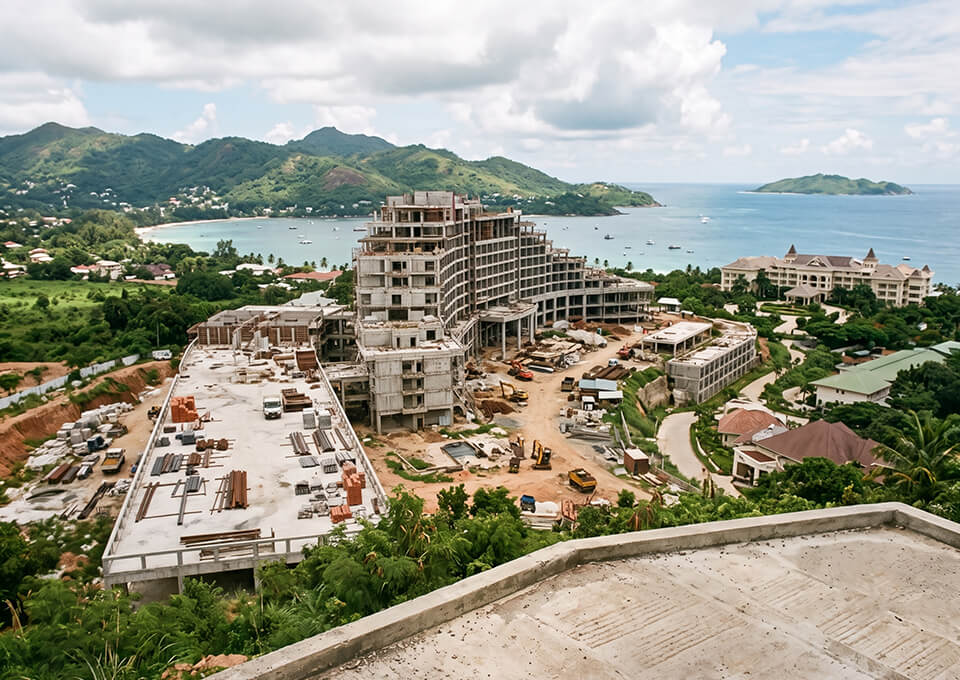
Construction cost inflation has emerged as one of the most significant and most persistent challenges facing real estate developers across Mauritius and the broader Indian Ocean region in recent years. The combination of global supply chain disruption, currency movements that have affected the cost of imported materials, rising labour costs driven by competitive employment markets, and logistics cost increases has collectively pushed construction costs substantially above pre-2020 levels across the island, creating a new cost environment that is fundamentally changing the economics of development across all asset categories.
For developers who have been active in the Mauritius market across multiple cost cycles, like the Apavou Group, which has been developing quality real estate in Mauritius for more than four decades under the leadership of founder Armand Apavou, rising construction costs are not a new phenomenon. The group has navigated multiple periods of cost pressure in its development history, including cost escalations associated with global commodity price cycles, exchange rate movements, and labour market tightening on the island. This historical experience, embedded in the group’s institutional knowledge and expressed across landmark developments including Plaisance Mall, Terre d’Été, and The Cube, provides an informed perspective on the current cost environment and its implications.
The scale of the cost increase, what the numbers show
Construction cost indices for Mauritius over the past four to five years reflect increases that are material and persistent rather than temporary or modest. Across the major cost categories, structural concrete and reinforcement, imported finishes and fittings, mechanical and electrical plant and equipment, and skilled labour, costs have risen substantially relative to the baseline that existed before the disruptions associated with the Covid-19 pandemic and the subsequent global supply chain and inflation environment.
The specific magnitude of cost increases varies by project type and specification. High-specification residential and commercial development, which depends more heavily on imported materials, specialist plant, and premium finishes, has experienced larger absolute cost increases than standard construction, where local materials represent a higher proportion of total cost. Coastal and hospitality construction, which requires specialist materials and construction methods appropriate to the demanding tropical marine environment, has experienced particularly significant cost pressure given the combination of material quality requirements and the cost of importing from international suppliers at elevated freight costs.
The import dependency driver, Mauritius’s structural cost vulnerability
Mauritius’s geographic reality as a small island located far from major manufacturing centres creates a structural vulnerability to construction cost inflation that is more acute than in continental markets. The island depends on sea freight for virtually all construction materials and equipment that cannot be sourced locally. Structural steel, specialist finishes, mechanical plant, electrical systems, and many categories of architectural components must be imported from suppliers in South Africa, Europe, Asia, and elsewhere. This import dependency means that construction costs in Mauritius are directly exposed to multiple external cost drivers: the price of materials at their source, the cost of maritime freight, port handling charges, import duties, and the exchange rate between the Mauritian rupee and the currencies in which materials are priced.
Each of these drivers has contributed to the cost increases experienced in recent years. Global commodity price inflation has increased material costs at the source. Freight rates experienced dramatic increases during and after the Covid-19 period as shipping capacity was disrupted and demand surged. Import duties have added a further layer of cost to categories of imported construction material. And the gradual depreciation of the Mauritius rupee against major source currencies has meant that each unit of imported material costs more in rupee terms. The combined effect of these factors on total construction costs for a typical Mauritius development is substantial.
Labour cost inflation, the domestic driver
Alongside the import-driven cost increases, domestic labour cost inflation has been a second significant driver of construction cost escalation in Mauritius. The island’s construction labour market has experienced real wage growth driven by competition from expanding sectors, such as financial services, technology, and hospitality, that compete for the skilled workforce that construction activity requires. Skilled tradespeople, electricians, plumbers, specialist finishers, and experienced construction managers can command wages significantly above those that prevailed five years ago, reflecting both market tightening and the increasing quality expectations of developers and their clients.
The impact on development feasibility
The most direct and consequential impact of rising construction costs is on development feasibility, the financial viability of bringing new development to market at prices that the market can absorb. The fundamental feasibility equation for any development project requires that end-user prices (either sale values or rental yields capitalised into capital values) exceed total development costs (land, construction, fees, financing, and profit margin) by a margin sufficient to reward the development risk taken.
When construction costs increase substantially without a corresponding increase in achievable end-user prices, either because market conditions limit price increases or because demand is not sufficient to absorb higher prices, the feasibility of development projects deteriorates. In the Mauritius market, the response of end-user prices to cost inflation has been mixed: premium residential prices, supported by sustained international buyer demand, have in many cases increased sufficiently to maintain feasibility, though at compressed margins. Commercial development, where rental growth has been more modest and where tenants have alternatives, has been under greater pressure, with some development concepts that were feasible in the pre-inflation cost environment becoming marginal or unviable without either significant price improvement or cost reduction.
How experienced developers are responding
Experienced Mauritius developers like the Apavou Group are responding to the elevated cost environment through several interrelated strategies. The most fundamental is more rigorous cost modelling in development feasibility, abandoning the optimistic cost assumptions that may have been acceptable in a more stable cost environment and replacing them with current market data on actual contract prices, with explicit contingency provisions that reflect the cost volatility that characterises the current environment.
Value engineering, the collaborative process of identifying opportunities to achieve development objectives at lower cost without compromising quality, has become an even more important component of the development design process than it was in previous cost environments. In the current environment, value engineering is focused not on reducing specification quality but on finding more cost-efficient ways to achieve the same performance outcomes, substituting locally available materials where quality equivalence can be demonstrated, redesigning building forms and systems to reduce cost without compromising functional performance, and procuring specialist materials from alternative sources where price competition can be stimulated.
Contract strategy in a high-cost environment
The approach to construction contracts in a high and volatile cost environment requires careful calibration between the competing risks of cost certainty and contractor performance. Fixed-price contracts transfer cost escalation risk to contractors but may be difficult to obtain at commercially acceptable prices if contractors are unwilling to absorb cost volatility risk. Cost-reimbursable or cost-plus contracts provide more certainty of contractor performance but transfer cost escalation risk back to the developer. Target cost contracts, which share cost variance between developer and contractor against an agreed target, represent a middle ground that aligns incentives more effectively in volatile cost environments.
The choice of contract strategy in the current Mauritius cost environment requires assessment of the specific volatility profile of the project’s key cost categories, the financial capacity of the contractor to absorb cost risk, and the developer’s own appetite and capacity for cost exposure. For the Apavou Group, the depth of contractor relationships and market knowledge built over four decades provides an important advantage in contract strategy, enabling the group to assess contractor capacity and risk appetite accurately and to structure contracts that achieve appropriate risk allocation without the pricing premiums that arms-length contract negotiations in less familiar market relationships would typically require.
The longer-term implications for the Mauritius development market
The sustained period of elevated construction costs has longer-term structural implications for the Mauritius development market that extend beyond the immediate impact on individual project feasibility. Most significantly, higher construction costs raise the replacement cost of existing quality assets, making the acquisition of existing completed buildings a more attractive proposition relative to new development for investors who are less willing to pay the development premium that new construction now requires. This shift in the relative attractiveness of acquisition versus development may gradually increase demand for and prices of quality existing assets as developers and investors reassess their relative financial merits.
Higher construction costs also accelerate the quality bifurcation of the Mauritius real estate market, making it increasingly difficult for below-quality development to achieve the prices needed to be financially viable, while quality developments in quality locations can still justify the cost of premium construction through the premiums they achieve in the market. This bifurcation reinforces the investment case for quality assets in the existing Mauritius market, including assets like Plaisance Mall, Terre d’Été, and The Cube, whose replacement cost is now substantially higher than their original development cost.
Managing cost inflation as a permanent feature
Construction cost inflation in the Indian Ocean region is not a temporary anomaly that will reverse to pre-2020 levels. It is the new cost environment within which development in Mauritius will operate for the foreseeable future. Developers who recognise this, who update their feasibility frameworks, their contract strategies, and their value engineering practices to reflect the current cost reality rather than historical norms, will be better positioned to identify viable development opportunities and to deliver them successfully in the current environment. For the Apavou Group, the institutional experience of managing through previous cost cycles provides the analytical foundation for navigating the current environment with the discipline and effectiveness that sustained development quality in the Mauritius market requires.
 Previous Post
 Next Post