

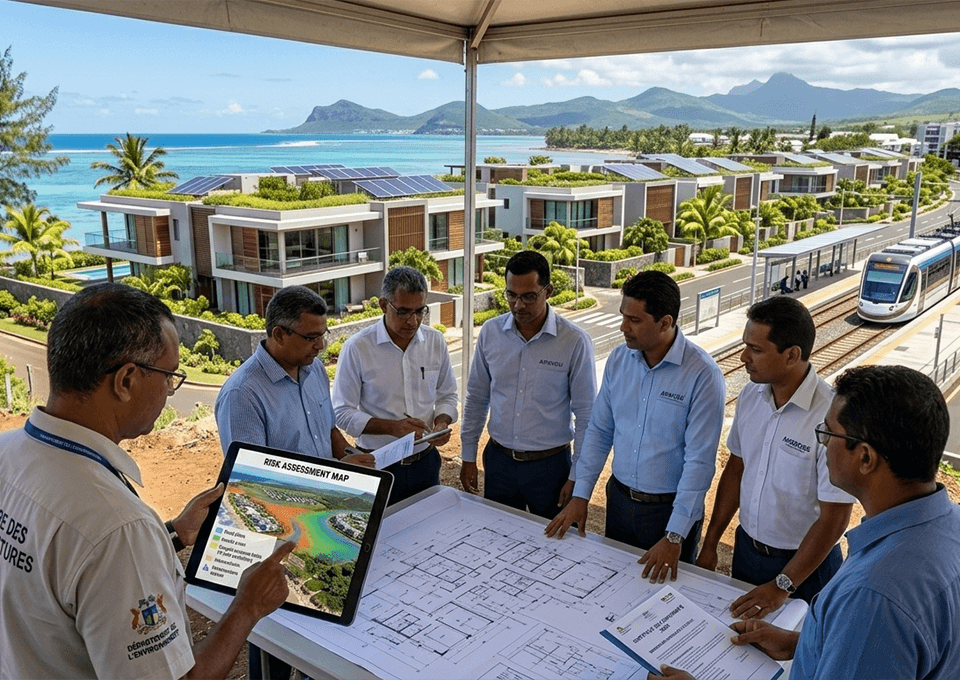
The Mauritius real estate regulatory environment continues to evolve in 2026, with several developments of varying significance affecting the conditions under which property development projects are designed, approved, financed, and delivered on the island. For developers, investors, and buyers active in the Mauritius market, staying current with these regulatory changes is essential, both to ensure legal compliance and to understand the opportunities and operational constraints that the evolving framework creates across different project categories and investment structures.
The Apavou Group, which has been navigating the Mauritius regulatory environment for more than four decades under the leadership of founder Armand Apavou, understands that regulatory change is a permanent and expected feature of the development landscape rather than an exceptional disruption. From the early frameworks that first opened the island to systematic foreign real estate investment, to the progressively more sophisticated and sustainability-focused standards of the present day, the group has consistently engaged constructively with the Mauritius regulatory framework, treating compliance as a foundation of credibility and seeking to anticipate the direction of regulatory evolution rather than simply reacting after the fact.
Environmental and Sustainability Regulatory Developments
One of the most consequential regulatory trends affecting property development in Mauritius in 2026 is the continued and accelerating strengthening of environmental and sustainability requirements. The Mauritius government has been progressively enhancing the environmental impact assessment framework for real estate development, with particular focus on coastal development, where the interface between construction activity and the island’s ecologically sensitive marine and coastal ecosystems requires increasingly careful management and mitigation.
New developments in coastal zones are now subject to more rigorous environmental impact assessment requirements, including significantly more detailed assessment of potential impacts on reef and lagoon ecosystems, more demanding setback distance requirements from the coast, stricter conditions governing construction methodologies near the shoreline, and enhanced monitoring obligations during both construction and operation phases. These requirements affect both the design parameters of new coastal developments and the timelines for obtaining environmental clearances, which developers must now factor into their project programmes as a source of meaningful regulatory risk that can affect financing and marketing schedules if not adequately planned for.
Building Energy Performance Standards, The Trajectory for 2026
Building energy performance standards in Mauritius are being progressively strengthened in 2026, reflecting both the island’s commitments under international climate frameworks and the practical national interest in reducing Mauritius’s significant dependence on imported fossil fuels for electricity generation. New commercial and residential buildings above defined size thresholds are increasingly subject to minimum energy performance requirements, including provisions for solar photovoltaic installation, specified minimum standards for cooling system efficiency, building envelope thermal performance requirements, and LED lighting standards for common areas.
For developers like the Apavou Group, whose commitment to quality construction already incorporates many of these energy performance standards across projects like Terre d’Été, Plaisance Mall, and The Cube, these regulatory developments represent confirmation of existing practice rather than a significant additional compliance burden. For developers who have not yet invested in high-performance building design capabilities and processes, the strengthening regulatory standards create real compliance costs and design complexities that must be factored into project feasibility calculations from the earliest stages of project conception.
Green Building Certification in Mauritius, Growing Market Relevance
Green building certification, through internationally recognised frameworks such as LEED, BREEAM, or the specific Mauritius Green Building Council assessment framework, is becoming increasingly relevant as both a market differentiator and, in some project categories, as a condition of preferred financing or premium tenant attraction in the Mauritius development market. International institutional lenders active in the Mauritius market are progressively incorporating sustainability performance requirements into their lending criteria. Global corporate occupiers seeking office space in Mauritius, particularly in the Ebene business district where The Cube and comparable developments are located, are increasingly expecting certified sustainability performance from the buildings they occupy. Developers who have not yet built the capability to design and deliver certified green buildings face growing competitive disadvantage in accessing the most creditworthy financing and the most desirable commercial tenants.
Foreign Investment Regulatory Developments
The framework governing foreign investment in Mauritius real estate continues to be refined in 2026. The Mauritius government’s ongoing review of the structure and parameters of the existing investment schemes, IRS, PDS, Smart City, and Ground+2, reflects the continuing effort to ensure that the framework attracts high-quality international investment while delivering meaningful and demonstrable economic benefits for the Mauritius economy and local population.
Adjustments to minimum investment thresholds, modifications to the eligibility criteria for residency permits associated with qualifying property acquisitions, and refinements to the conditions governing short-term rental activities within scheme properties are among the regulatory areas of evolution that international property buyers and developers need to monitor closely and accurately. These changes can affect the relative attractiveness of specific development schemes, the economics of individual acquisition decisions, and the competitive positioning of Mauritius relative to alternative destinations in the Indian Ocean region for international property capital.
Smart City Scheme Developments, Regulatory Evolution in 2026
The Smart City Scheme continues to be one of the most significant regulatory frameworks for large-scale mixed-use development in Mauritius in 2026. The scheme, which provides a comprehensive regulatory and fiscal framework for the development of integrated urban environments that combine residential, commercial, educational, healthcare, and leisure components, has attracted multiple major development commitments and continues to be refined in response to implementation experience and evolving market expectations.
Developments operating within the Smart City Scheme framework must meet specific qualifying criteria regarding land area, masterplanning standards, infrastructure quality, innovation technology requirements, and community amenity provision. The continued evolution of the Smart City regulatory framework in 2026 is making the scheme more comprehensive and, in some respects, more demanding for developers, while also providing greater certainty for international buyers about the baseline quality standards they can expect from qualifying developments. Several significant new development commitments within the Smart City framework are anticipated in the near term, which will add meaningful new supply to the Mauritius premium property market.
Planning and Development Control Regulatory Updates
The planning and development control framework in Mauritius, which governs what can be built where, at what density and height, with what infrastructure requirements, and subject to what community consultation processes, continues to be modernised and refined in 2026. The progressive rollout of digital planning submission and tracking systems across the island’s planning authorities is improving the transparency and predictability of the planning process, reducing some of the administrative friction that has historically added time and cost to the planning phases of Mauritius development projects.
More substantively, planning policy in several areas of Mauritius is being reviewed to reflect evolving national priorities, including greater emphasis on affordable housing provision as a counterbalance to the premium market focus that has characterised much recent development activity, greater encouragement of mixed-use development patterns that reduce private car dependence in the island’s more congested urban areas, and strengthened protection of remaining agricultural land and natural green spaces from speculative development pressure. These policy directions will shape the development opportunities available in different parts of the island over the medium term and should be carefully understood by developers and investors assessing the long-term development potential of specific sites.
Practical Implications for Active Developers Including the Apavou Group
For developers with active projects in Mauritius, including the Apavou Group, whose development programme spans multiple project stages at any given time across the island, the regulatory changes described above have specific and practical operational implications. Projects that are already in detailed design or physical construction phase are largely insulated from new requirements that take effect prospectively on future planning applications. However, projects in early feasibility and concept design stages must incorporate the latest regulatory requirements from the outset of the design process.
Failure to incorporate current regulatory requirements during early design can lead to costly and time-consuming redesign obligations later in the project lifecycle, at a stage where changes are significantly more expensive to implement and where programme delays have real financing and opportunity cost consequences. The Apavou Group’s approach to all new project development in Mauritius incorporates early regulatory assessment as a standard component of the project inception process, ensuring that design work proceeds on a fully informed regulatory basis from the first concept stages.
Looking Ahead, The Direction of Mauritius Regulatory Travel
For developers and investors seeking to anticipate the direction of Mauritius regulatory evolution beyond the immediate 2026 changes, several clear thematic trends are evident in the government’s policy priorities and in the wider international regulatory context that inevitably influences Mauritius’s regulatory approach as a globally connected small island state.
Sustainability and environmental performance requirements will continue to strengthen, driven by international climate commitments, by the practical vulnerabilities of small island nations to climate change, and by the increasing expectation of international buyers and investors for certified environmental performance. The foreign investment framework will continue to evolve, balancing the economic imperative of attracting quality international capital with the social imperative of managing the community impact of development and preserving housing access for Mauritians. And digital transformation of regulatory processes, planning, building control, environmental assessment, will continue to improve the speed, transparency, and predictability of regulatory engagement for quality developers.
Staying Ahead of the Mauritius Regulatory Curve
In the Mauritius real estate development market, staying ahead of regulatory change is not just a compliance obligation, it is a genuine source of competitive advantage. Developers who understand the direction of regulatory travel, who anticipate where standards are heading rather than simply reacting to where they currently are, design more compliant, more marketable, and more financeable projects. They attract the international buyers and institutional tenants who increasingly demand regulatory certainty and sustainability performance. And they access the more favourable financing terms available to demonstrably compliant, high-quality developments. The Apavou Group’s four-decade engagement with the Mauritius regulatory environment positions it well for continued success in a landscape of ongoing regulatory evolution.
 Previous Post
 Next Post